I have to confess. I wish.. to confess!

One of the best moment of TV series history. I had chills watching it for the first time.
Okay now.. focus. F.O.C.U.S.
So the confession is, that I had been having troubles reading books. It was because the current book in my reading queue is Meditations on First Philosophy by Rene Descartes. And this book is super super hard to read. Maybe I’m stupid. But I already searched the summary through ChatGPT, I also tried looking for detail explanations on Google, Youtube, Quora, you name it, but no answer satisfies me. I feel like there’s something more to the actual book than those summaries.
So what I’m gonna do now is to read carefully chapter by chapter; one by one. And remaking the book with my own language. Of course there will be misinterpretation, after all, I’m not a philosophy student, let alone expert. I’m just a regular chemical engineering graduate who eventually works at his father’s factory because the money here is much more promising. And it lets me have the lifestyle I yearned for my entire life.
Okay without much further due, I’ll begin.
LETTER
Okay first of all he addressed this book to deans and doctors of University of Paris. Then he stressed the importance of proving the existence of God and continuity of the soul (TEoG & CoTS) through philosophical means rather than theological means, so that unbelievers can be convinced better.
*let’s pause*
I wanted to show you how difficult it is to read this book, so here is the screenshot of a part I will sum up.
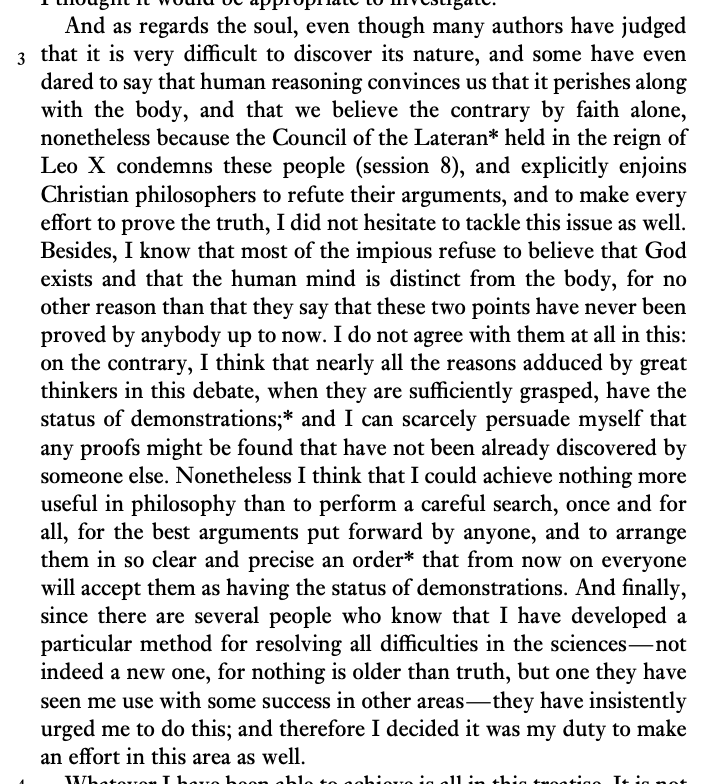
my summary is:
Since soul continuity doesn’t have proof, he will bring forward an argument so clear and precise by using his method of finding the truth.
Good enough? Okay let’s continue.
*continue*
Then he mentioned that all his work is put in this book, and he argued to prove those 2 things (TEoG & CoTS) by bringing primary and only most important arguments and he dared to bring those arguments as demonstrations. No other better arguments can be found by human intelligence (I like his confidence). But he was also doubtful that his argument can be grasped by people. The search for truth is more important than challenging the soundest views.
At last, he told the professors that he sent his work to them because they can bring impact since everyone respects University of Paris. And also asked them to correct if there’s error and complete if there are gaps and imperfections. He believed if they bring forth his proof, people will believe the existence of God and continuity of the soul. In the end he mentioned that he put his trust on them since they are known to support Catholic Church.
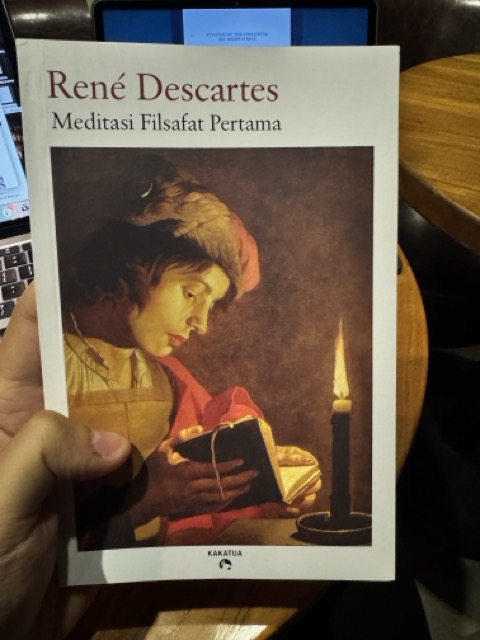
The book cover. But I read the English version that can be freely found on the internet.
PREFACE
He mentioned that this topic was discussed in his previous book: Discourse on Method; but not in depth since he wanted to learn readers’ response to it and judge accordingly. Also in Discourse on Method, he asked readers to criticize his work, but only 2 objections worthy to note.
- Although human mind does not perceive itself to be anything other than a thinking thing, it does not follow that its nature consists purely in its being a thinking thing, purely means excluding everything else that might be said to belong to its nature. (I’ve read it multiple times and I almost fainted doing so).
–> Descartes replies: his meaning was that he was aware of nothing at all that he knew to belong to his essence, except the fact that was a thinking thing, or a thing possessing the faculty of thinking. However, in the present work he will show how, from the fact that he knew nothing else as belonging to his essence, it follows that nothing else in fact belongs to it.
Do you understand? Neither do I.
After reading again, I’ll translate again into my own version. Basically here it goes.
Objector : Dude, you said that you, a human mind, can’t perceive yourself as something other than a thinking thing. Just like the quote: I think therefore I am. – Like you can’t perceive yourself as a breathing being because you could have been deceived by evil spaghetti octopus demon to believe you are breathing. – But human mind’s nature doesn’t consist only in it being a thinking thing.
Descartes : I don’t care what you think a human mind’s nature is, but from my meditation, the only thing I’m sure is that I’m a thinking thing. But I will show you that from the fact that I don’t know any other thing that belongs to “me” other than thinking, it follows that in fact nothing belongs to “me”.
I’ve tried my best…. - It doesn’t make sense that I have an idea of a more perfect thing than myself, that the idea itself is more perfect than me. More doesn’t make sense that the thing represented by this idea exists.
–> Descartes replies: his definition of idea is ambiguous. In this book he will shows that from the fact that he has an idea of a more perfect thing, the thing itself actually exists.
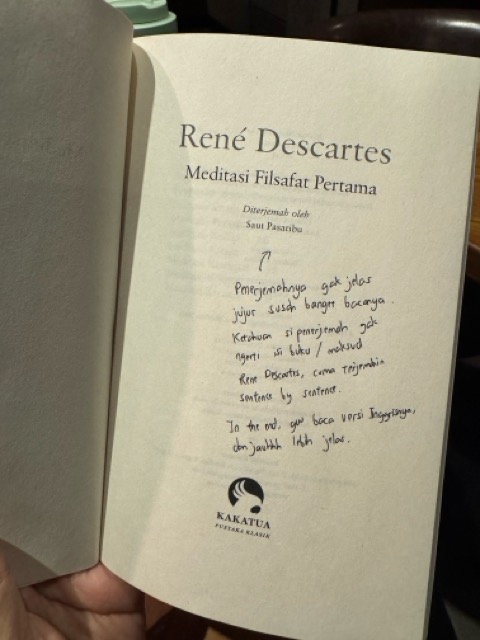
my frustration when reading the Indonesian version of the book, which feels like translated lazily with Google Translate.
There are other many arguments attacking his conclusions, but he chose to ignore them since it completely missed his point for his proof of the existence of God; by them imagining God has human emotions; and by them deciding from their morality what God must and must not do. And Descartes is sure that if people follow his chain and connection of his arguments, they will understand how solid his arguments are.
Lastly in the preface, he will explain later in the book his thought process, and in this book also he will reply to objections; he also wants reader to fully read through all the objections and his replies before passing judgement.
 Goofythinker