It’s final already because I already finished the book.
Only after finishing the book that I realize, we don’t really need to finish a book by reading through all pages thoroughly, especially self-development non-fiction books. Because sometimes there are pages that might not be relevant to us.
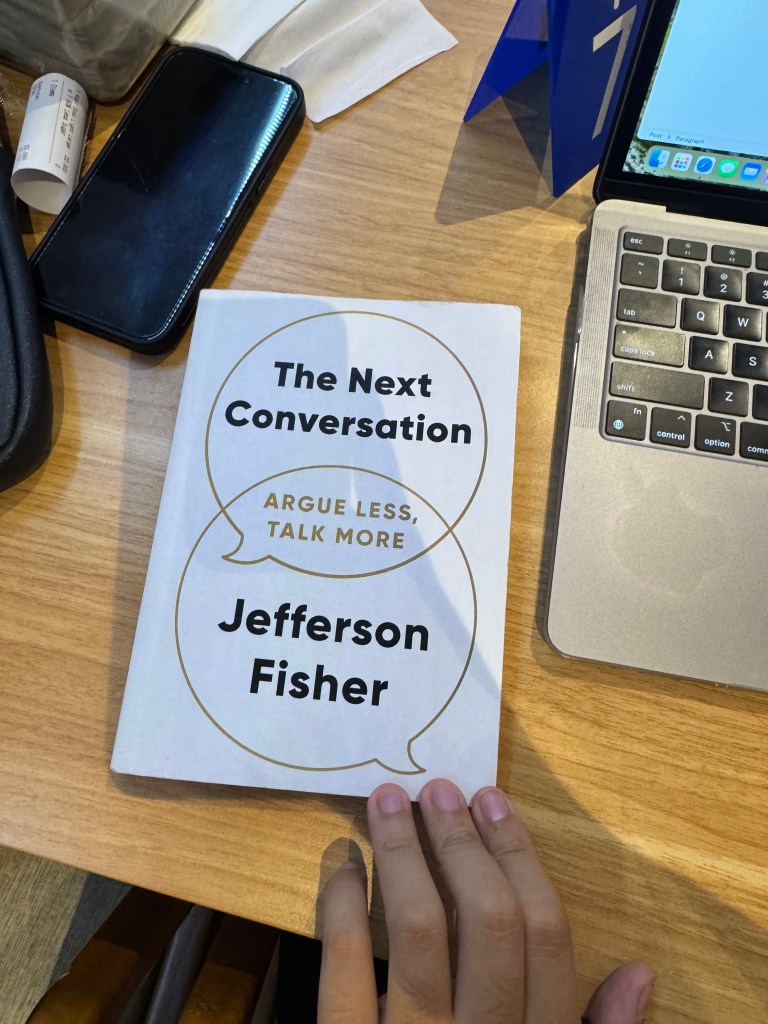
For this book specifically, I bought and read this book because I expected that after reading this, then when I had a conversation with someone, mostly strangers or someone I’m not really close with, I can have smooth conversation.
But apparently this book is not about that.
Basically this book tells you how we can have meaningful conversation with someone if we already have the purpose of the interaction, such as we want to tell them about something, we want to have discussion, we want to fire them, etc.
For me, whenever I already know what the interaction’s going to be, I find it easy to have conversation. The hard part is when we don’t really have anything to talk about, but I want to make conversation.
So, the conclusion is that I’ve read this book for nothing. Well not really, there’s a lot of insight I got from this book that I could use when I finally need to have a difficult conversation. The best ones are:
1. Never win an argument, seek to understand.
2. Control the moment: take a breath, do a quick scan, have a small talk to yourself.
3. Control the pace: use pause strategically.
4. Frame your conversation.
5. Always have the positive mindset.
6. Recognize narcissist and deal with them accordingly.
There are also a lot of things I learned by reading this book, that is not only about how to have meaningful conversation. It happened just today.
Just today I talked with my family member about our vice president, Gibran. I told her about the news that he invited fake online drivers to have a talk. And not long after, his fake online drivers representative gave a statement, more or less, “Chicken burglar got sentenced 5 years, Affan’s killer only got special arrest?” I told her that Gibran was dangerous to the president, Prabowo. He tried to appeal with masses, so that Prabowo falls, then he becomes President. She answered, “good.”
Good? What do you mean good? Do you still believe Gibran is one of the good guys? I know you are Jokowi’s fans but how can you be so stupid? I know your opinion doesn’t matter since you are not that smart. All your academic achievements was because you studied diligently, but try your logic. Pretty sure it sucks.
My blood rushed to my head. Those are all I thought in a few seconds. But I kept my silence. Then I asked myself, what made me so angry from her “good” answer. Then I realized, this is what is taught in this book. This is one of my trigger. When she said that, to me it was a threat to my personal identity. My belief is that Gibran is one of the bad guys. By saying that, she basically questioned my judgement that Gibran is a bad guy. By questioning my judgement, subconsciously I perceived that my intelligence was also being questioned. That’s why I was so angry.
By recognizing this, then I took a breath and controlled myself. Realizing that maybe everyone was exposed to different bubble of information. I could be wrong, too (even though when I’m writing this, I’m sure with myself.) And however smart or stupid she was, it didn’t matter, she was a person that needed to be respected. And a disagreement was just a disagreement, it was not an attack to my intelligence. I kept my composure, my head still ran a little hot, but I told myself it was a physical response of my subconscious self. My conscious self knew better.
After her comment, I just kept silent and basically ignored it since it was a light conversation. I learned that it is best to avoid politic-related topic if you already know the other party has opposing views with what you believe is true. If you don’t know, don’t start. If you know you have the same view, it means it’s safe to talk.
In conclusion, apparently this book is pretty useful.
 Goofythinker