A Thought About The Next Conversation: I

The 1 in roman was only the precaution in case I decide to have another thought about certain part of this book. I’m currently writing this while listening to Otis Redding’s Try a Little Tenderness, in a FamiCafe nearby while watching a couple in the side of my eye basically cuddling in public.

It was mentioned in this book on chapter 2: the next conversation that when having difficult conversation, we have to decide the goal of that conversation first, and the goal has to be realistic and specific, more or less. He gave an example such as “I want to hear their perspective without getting defensive,” or “I want to listen without interrupting.”

And then he showed some example, basically when having conversations, we have to keep in mind that our goal is to connect with them. All of his example was when we say sorry first and try to listen to their perspective then they will be nice to us back, then we understand each other, and live happily ever after. I just wondered, it was not that ideal in real life. If we have beef with another person, then that person most likely a selfish jerk (or it could be ourselves, we just don’t realize it). We can only wish his response would be something like, “I understand, I’m sorry too.” And what if he closed himself? Conversation can’t happen if one party closed himself. In this book, at least until chapter 2, he hasn’t mentioned how we should have “the next conversation” with these kind of people.

Also, what about some conversations that are better swept under the rug? Because these kind of conversations exist too! I strongly believe not everything has to be talked about. Just like this clip from modern family.

Am I.. a hypocrite? (This chapter is for you, Tini)

This story began 2 months ago when our helper resigned. Her name was Tini. She was short, dark skinned, not exactly fat but her body was big, and her feet were unusually large – I suspected she had “elephant feet syndrome”. If I should guess her age, maybe around 40-something. Nothing special about her appearance, her eyes were big (or belo in Indonesian), her hair was short, and if I imagined her resting expression, I think she always looked a bit worried, as if there’s a debt she kept thinking about. She often wore T-shirt and regular pants, whose length right about knee high.

What was so special about Tini wasn’t her appearance, it’s about her work. As a helper, she was responsible for cleaning our houses, and sometimes he could do other things which is not in the helper’s jobdesc like receiving package and turning off stove at certain time. From her work, you could immediately tell that she was passionate about her job. If not passionate, then she did it with seriousness while packing a lot of experience. She was not as quick as most helpers but she cleaned every corner flawlessly. And there’s also her attention to detail, she could put things where they belong, as if the items were hers. While doing all of that, she was also very considerate with her words. She was polite and she knew what to say and what not to say.

Unfortunately, she had to resign because her daughter had just given birth to a baby, and as a grandmother, she helped taking care of it.

Then not long after she resigned, there is a new helper, her name is Siti, which is our helper now. At her first day, I barely noticed anything, except that she was unusually chatty and loud. But I put no mind to it since I perceived it as normal. After all, she was new and no wonder she wanted to know more about the work to be done in our place.

But then strangeness after strangeness emerged. First, the print on my clothes were cracking. I wasn’t mad at all, shocked? yes because it never happened before. Then I suspected that maybe when ironing, she put the iron directly on the print.
I came to her, “mbak, my clothes were cracking, can you avoid the print when ironing next time?”
She said, “No! It was not me, I always avoid ironing the print, maybe it’s the washing machine.” then she showed me how she ironed the shirts while avoiding the print.
I thought, oh! she already avoided ironing the print, maybe it’s indeed the washing machine. Maybe she used another setting that caused the print to crack.
“Okay mbak” and I was then in pursuit of solving the problem, I wanted to know what really caused this and prevented it from happening again to my other clothes.
Then I called my household expert, my mom, “Mom, the print on my clothes were cracked, it’s never happened before, do you know the possible cause of this?” My mom then knew exactly what caused this and it was indeed the iron! She then told me she would taught Siti how to iron correctly. And since then, all my clothes are now safe. I just wondered, why did she avoid accountability before?

And then while working, sometimes she would stop doing what she did, and asked a very unimportant question to me, such as when I weigh my weight, she would stop sweeping, raise her head a little, like she wanted to peek at the number, and asked me what my weight was. And then this is so weird, when, for example, I went to the kitchen to take some glass and water, she, who was in another room, could stop whatever she was doing, and asked me with her loud voice, “ko, are you looking for glass?” Keep in mind it happened so many times and it annoyed me. Because:
1. She stopped working only to ask something that’s really not related to her work.
2. I had to answer a really unimportant question. Otherwise, it’s rude. To be honest, I ignored her a few times when I was not in the mood.

But I didn’t hate her. Siti was not exactly the perfect helper, but despite her insensitiveness, she had a good heart. Just sometimes (by sometimes I mean, often) what she did annoyed me. To give you more context, Siti introduced another helper for my sister, and this other helper confessed that she couldn’t have conversation with Siti because she often talked nonsense.

Sometimes when I looked at Siti (cielah), I imagined my old self trying to fit in with other people. I was very insensitive, my world and their world were different. What considered okay in where I grew up could be considered rude by them. And of course I would sometimes say the wrong things. Am I a hypocrite if I am annoyed by Siti for her insensitiveness? Am I allowed to be annoyed?

Just before I wrote this in a Starbucks cafe nearby, while riding a motorcycle I passed her riding her bicycle. She smiled at me widely, greeting me, “Koh” and I gave her a smile back, “halo mbak.”

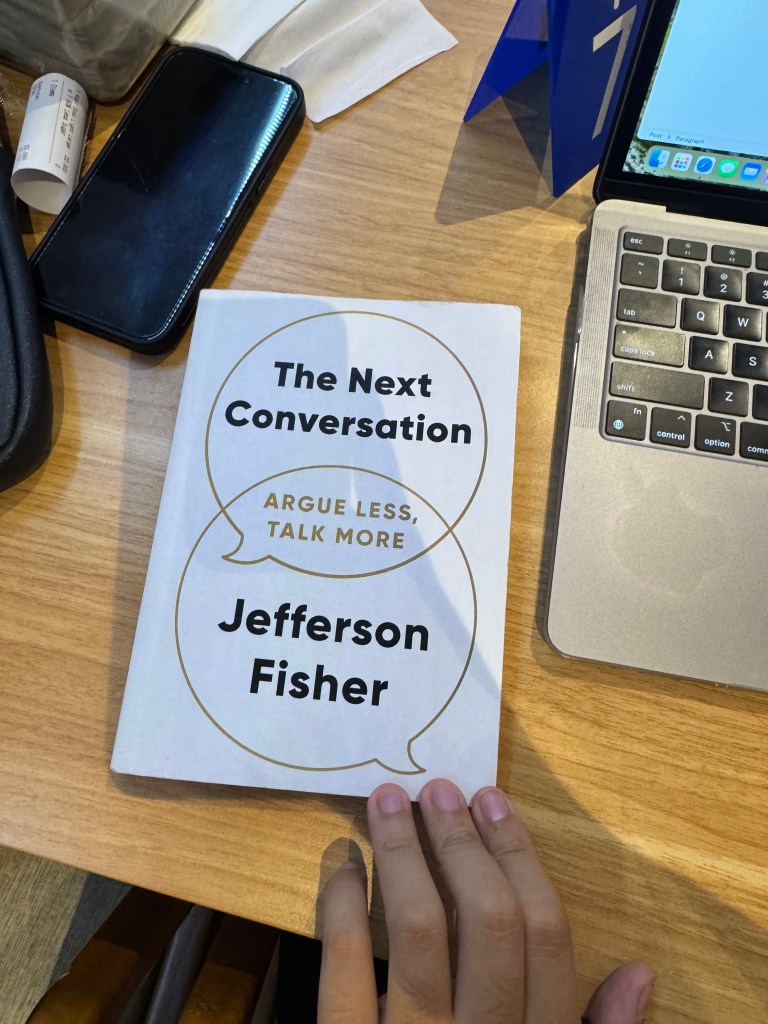
The Next Conversation: Argue Less, Talk More

When I first encountered this book, I thought this book is about how we can make a meaningful conversation with some strangers or someone we already know. I just realized I was wrong after a few pages into this book. The author specifically explained that this book answer 3 questions:
1. How do I talk to someone who’s defensive?
2. What do I say when someone belittles me?
3. How do I assert my boundaries?
and here are the answers to these questions: say it with control, confidence, and to connect.
Okay… not exactly what I’m looking for.
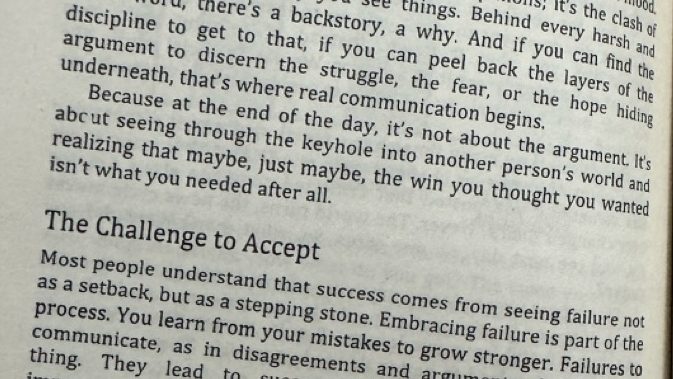
But maybe it can be useful when for example in business setting, I encounter a difficult person. Instead of my usual resort -let them be, just focus on the objective- maybe this time being friendly to them can be a good strategy. To be honest I haven’t finished chapter 1 yet, but so far I think his method only works if the person we encounter is inherently good. If the person we talk to is hostile to us, then there’s no way we can have meaningful conversation with them. Moreover, it’s pointless if we try to change his opinion about us.

Maybe there’s more to this book than what I imagined. I will finish reading it and give the review later.

But why is it always us who see through the keyhole into people’s world? I also want people to see my hole (pun intended).

Overthinking: blessing or curse?

If you know me and read my blog, I’m guessing you can kinda see what kind of a person I am in terms of thinking. I think about a lot of things-thus my goofythinker name. I have been this way since I can remember. I don’t think the people around me during my childhood, overthink as much as I do.

Because of this excessive thinking, sometimes I could be too sensitive.
Like for example, if I was driving a car, and I passed another car, I could be thinking, “what if the person inside that car cursed at me?” Multiple scenarios happened in my head. I imagined I explained to the cursing man what actually happened. He kept being angry. I explained. The thought that someone saw me as a bad person worried me unnecessarily.
Second example, my sister said bad things about me? I 100% had to correct them because if not, her perception would become reality. I couldn’t let go and we would fight. Compared to now I can totally ignore her.
That’s how severe it was. It led me to emotional instability during my teenage years especially in the family because no one seemed to understand me.

But today I saw this as a blessing. I’ve overcome the anxiety that comes with excessive thinking. I’ve learned mostly through the people I’ve met in my life, and I thanked them for it. For example during my university years, there’s someone who often blurted, “bodo amat” whenever he would do something stupid. I secretly copied his approach to life and to be honest in life sometimes we have to “bodo amat” at things. And there are many other things in life that shaped me to become who I am today.
– to English readers, “bodo amat” means who cares.

And for my excessive thinking, I’ve now taken advantage of it. Since now I am able to control it, I can now direct my thinking to the things that matter. I can write with so much thought because of it. I understand philosophy better because of it. I can be thoughtful about other people because of it. I am now wiser because of it. I navigate through life with less drama because of it.

And this is the quote that best describes how I now wear my overthinking as.

and to conclude, I think the answer to the title was: it’s a blessing. Since I am born as a package with overthinking tendencies, what better way than to treat it as a blessing?

The importance of passion

I like singing. I do it every time I’m driving, while I’m by myself, or when I’m feeling like it.

A few days ago I attended a musical class: sing by jktarthouse. It’s out of my usual zone, but I convinced myself it’s good to try new things. Since I’m confident in my ability to sing, I thought it was going to be easy. And oh boy how wrong I was.

While singing in choir, we have to be sensitive enough to determine which note we are singing. Basically, you should have a good ear for notes. And because everyone was singing in each assigned notes, you will sing while unable to hear your own voice. I’ll be honest, it’s hard. And moreover, since it’s a group project and my voice range was baritone/bass, I should give up on the chance to sing by myself, because soloists are mostly sopranos and altos. Or to put it in another word, I feel like the complement in a group project.

To make things worse, while singing, my notes were all over the place.

Despite the terrible experience, I was totally happy I joined the class. Because I now unlock more about myself, what I like and what I don’t like.

I asked a friend who was in a choir group if what I experienced was normal and yes it was, but practice makes perfect. People will eventually be able to know which note to sing and sing accordingly. But I don’t think I want to do any more training to be in a choir group. It’s different from running or exercising. When I run or exercise, I exhaust myself and sometimes feel like giving up, but I keep doing it because I’m passionate about them, I like them, it makes me feel good. But this time, I just don’t feel the fire inside me.

Passion is the fuel for the soul.

Me, 2025

*notes: it goes without saying that in this context, I’m not talking about occupation. Passionate about your job is a good thing, but not everyone has the luxury to choose a job that suits their passion. I’m talking about hobby or doing anything in general.

Let’s talk about marriage

There are 2 activities where I meditate, having conversation with myself, and giving birth to great ideas: taking a bath and riding a motorcycle. One of these thoughts is about marriage.

I think about this when someone I followed on Instagram has just recently married. In previous videos before marriage, I saw his eyes were playful and full of energy. But after marriage, his gaze changed, more serious, joyless, and seemed like under pressure. (I kid you not, I kinda have this special power to sense). While noticing this, my mind wandered around different things: Why do we marry? Why do men and women marry? Do we marry because it makes us happy? Or because it’s a responsibility? Or because it’s expected? or is it because we love each other? How can we make promise to always be together forever when every day we see a different person?

I always think that marriage mostly benefits the women. Red flag. I know, but hear me out. First of all, in traditional sense, especially after having kid(s), they don’t have to work anymore. Basically men have to work harder to be able to pay living cost for two people, and more if kids are present. Before marriage, they only have 1 person to be responsible for. After marriage, they will have 2, 3, and more people to be responsible for. And then, from where I grew up, it’s always women who glorify the idea of marriage, as if it’s the purpose of their life, while men treat marriage as a responsibility.

But then I imagine myself entering women’s mind and suddenly my perspective changes totally. If I were a woman, then marriage is also a scary uncertain thing: Entering a new life with a new set of responsibility as a wife; Making sure the household is organized; Managing family’s finances; Making sure my husband doesn’t spend money irresponsibly; Being pregnant and having kids, need to do it with the right person; Nurturing the kids; If I work, I have to sacrifice my career to take care of kids, and what if my husband is infidel? I have to divorce and what about the career I have built so far?

And the reason why women glorify marriage? It’s because of societal pressure. Especially in Asian countries, women are expected to have kids after marriage. After certain age, it’s getting harder to have kids. That’s why they are eager to get married, because there is a time limit.

And then after considering both perspectives, I’ve come to a conclusion that marriage is harder for women. While men sacrifice their time and energy, women sacrifice their whole body and soul.
Please put in mind that I assume both men and women are both responsible people, not including those irresponsible judol addicted lazy husband and menye-menye rebahan habisin duit wife.
Knowing this, even though marriage is harder for women, but somehow they dreamt for it? Maybe they are built for pain? Maybe their tolerance for pain has been heightened by their monthly cycle, and now they treat pain as a challenge? Idk.

And then after short contemplation, to conclude my thinking, I think marriage is for building a family, to further the family name, in which the kids are at its core. I know I know. What if the family can’t produce a child and don’t want to adopt? To be honest, I don’t have the answer for that. For me, kids are the one thing where the husband and wife can work together to build. Without kids, I can’t imagine something else they build together. Maybe marriage doesn’t have to have something to build together. Maybe just companionship is enough. Or maybe without kids, there is still something to build and I just don’t know it yet.

Sometimes I also think, maybe marriage doesn’t have to be that complicated. If you love each other, you want to be with each other no matter what. Whatever comes after, we solve it together.
Funny thing. Even as I’m writing this. I’m having second thoughts. Just having love for each other will never work. It only happens in a fairy tale. The fact is this: love fades over time. To ensure marriage can last, respect is what’s needed. So that love can keep regrowing from respect.

I just cut someone off and here’s what’s going on in my mind

Before I begin, I’m telling you what’s happening around me.
I’m sitting at Fore Coffee in *secret location in case I got famous and someone stalks me in the future* on a Tuesday evening, listening to Creep by Radiohead. Feeling the music and not trying to sing along. It’s a perfect time to be alive.

By reading the title you might think, “ew why so negative” “nobody cares” “are you proud after cutting someone off?” Well it’s okay if you think all that, sometimes I have that kind of negative thought to myself, too. And sometimes I’m not always sure I do the right things. And that’s where narratives come to play, there’s always justified reason why I do things I do.

First of all, I want to declare that I’m a firm believer of a thousand friends too few, one enemy too many. That’s why I’ve been living my life in peace with no fear of enemies. If I don’t like a person, I would try to avoid confrontation and possible interactions as much as possible. In case we share the same location, well I don’t mind to move, or you can always find ways to not meet him. By avoidance, I’ve actually I’ve reduced the chance of someone becoming my enemy. I’m not really sure is this is the right approach to life. But I’ve found my peace by not seeing and even realizing that person exists.

But life is not always that simple. People are divided into unlimited spectrums. And I don’t think it’s wise to categorize people into good and bad people. People are combination of both. And the only thing that matters is how we perceive them. That’s why in the previous paragraph, I don’t avoid bad person, I avoid someone I don’t like.

Back again to the title. Now I’d like to tell you what happened.

Okay, so in my case, I know this person since university, let’s call him Jeff. Jeff was an atheist but recently he found his way back to his religion, which is Flying Spaghetti religion. In his religion, they believe there’s an invisible and imperceptible Flying Spaghetti God that all-knowing, all-seeing, and all-everything. He had taken interest in my religion, buddhism. A few years ago, he asked question about buddhism and I answered as best as I can. Then we still connected and occasionally discussed about politics. One day, out of the blue, which was recently, he asked questions about buddhism.

He asked, “Our condition now is the fruit of our previous life’s deeds. Does that mean Buddha see poor people and be like, “it’s your own fault, because you did a bad thing in the past life”?”
I thought, yes Buddha will know the cause of poor people’s condition but Buddha will certainly doesn’t think about blaming anything.
I answered, “Yes. And sometimes there’s the follow up question: poverty breeds conditions that make people do crime, like stealing. While poor people are more difficult to do charity, it’s easier for rich people to do it. Does that mean Karmic law is cruel? If you do good things, after being reborn, it’s easier to do more good things, while if you do bad things, after being reborn, you gravitate towards doing more bad things? But the answer to these questions is: that’s how it is.”
Then he asked, “I see and I understand, but that’s not an excuse to hate poor people, right?”
I was confused but I wanted to know more what he meant, “Not at all, who said that poor people must be hated?”
He answered, “”It’s your own fault” “Take that, it’s because you did a bad thing.” those things Buddha said.”
At that point, I exploded. First of all, Buddha never said those things. Second, I don’t understand how realizing someone’s condition is a fruit of his previous life is an excuse to hate poor people. Reading his text feels like he imagined Buddha as a hateful being that hates poor people. Like all of a sudden, where does hating poor people come from?? What does that even mean? Do I even exist? I could have said words that might hurt him about his Flying Spaghetti God but I chose not to. Rather than making enemies, I usually just resort to making him not existing. It leads to more peace and less enemies.

Maybe you’re wondering why I suddenly get angry at this question. It’s harmless, after all. Well just a few days ago, we had a little debate about Buddhism in Myanmar. He used buddhist extremists in Myanmar to justify his Flying Spaghetti extremists. But to me it’s so incomparable. I forgot what happened next in the conversation but in the end we just held back with our own opinions.

Then I did a quick checklist about this person on my mind:
1. What is he in your life? A friend.
2. What has he done? He tried to undermine my religion.
3. And how does it make you feel? Anger.
4. Do you think you can forgive this person? Can’t.
*this account has been blocked*
and bye.

Yeah that’s the story. I’d be lying if I don’t sometimes wonder if I did the wrong thing. Maybe I should listen more, maybe there’s another perspective that I didn’t see, maybe I shouldn’t be so impulsive and block him right away. I shouldn’t do this every time there’s a disagreement because in the end I will have no friend. Maybe if I held back a little, I could have changed his mind.

But in the end, it already happened. And there’s also another side of me that knows he tried to make me feel shameful about what I believe, and that’s the core reason why I did what I did. Since it already happened, no point in wondering if I did the right thing or not, better move on to life.

Meditations on First Philosophy – part 0

I have to confess. I wish.. to confess!

One of the best moment of TV series history. I had chills watching it for the first time.

Okay now.. focus. F.O.C.U.S.
So the confession is, that I had been having troubles reading books. It was because the current book in my reading queue is Meditations on First Philosophy by Rene Descartes. And this book is super super hard to read. Maybe I’m stupid. But I already searched the summary through ChatGPT, I also tried looking for detail explanations on Google, Youtube, Quora, you name it, but no answer satisfies me. I feel like there’s something more to the actual book than those summaries.

So what I’m gonna do now is to read carefully chapter by chapter; one by one. And remaking the book with my own language. Of course there will be misinterpretation, after all, I’m not a philosophy student, let alone expert. I’m just a regular chemical engineering graduate who eventually works at his father’s factory because the money here is much more promising. And it lets me have the lifestyle I yearned for my entire life.

Okay without much further due, I’ll begin.

LETTER

Okay first of all he addressed this book to deans and doctors of University of Paris. Then he stressed the importance of proving the existence of God and continuity of the soul (TEoG & CoTS) through philosophical means rather than theological means, so that unbelievers can be convinced better.

*let’s pause*

I wanted to show you how difficult it is to read this book, so here is the screenshot of a part I will sum up.

my summary is:
Since soul continuity doesn’t have proof, he will bring forward an argument so clear and precise by using his method of finding the truth.

Good enough? Okay let’s continue.

*continue*

Then he mentioned that all his work is put in this book, and he argued to prove those 2 things (TEoG & CoTS) by bringing primary and only most important arguments and he dared to bring those arguments as demonstrations. No other better arguments can be found by human intelligence (I like his confidence). But he was also doubtful that his argument can be grasped by people. The search for truth is more important than challenging the soundest views.

At last, he told the professors that he sent his work to them because they can bring impact since everyone respects University of Paris. And also asked them to correct if there’s error and complete if there are gaps and imperfections. He believed if they bring forth his proof, people will believe the existence of God and continuity of the soul. In the end he mentioned that he put his trust on them since they are known to support Catholic Church.

The book cover. But I read the English version that can be freely found on the internet.

PREFACE

He mentioned that this topic was discussed in his previous book: Discourse on Method; but not in depth since he wanted to learn readers’ response to it and judge accordingly. Also in Discourse on Method, he asked readers to criticize his work, but only 2 objections worthy to note.

  1. Although human mind does not perceive itself to be anything other than a thinking thing, it does not follow that its nature consists purely in its being a thinking thing, purely means excluding everything else that might be said to belong to its nature. (I’ve read it multiple times and I almost fainted doing so).
    –> Descartes replies: his meaning was that he was aware of nothing at all that he knew to belong to his essence, except the fact that was a thinking thing, or a thing possessing the faculty of thinking. However, in the present work he will show how, from the fact that he knew nothing else as belonging to his essence, it follows that nothing else in fact belongs to it.

    Do you understand? Neither do I.

    After reading again, I’ll translate again into my own version. Basically here it goes.

    Objector : Dude, you said that you, a human mind, can’t perceive yourself as something other than a thinking thing. Just like the quote: I think therefore I am. – Like you can’t perceive yourself as a breathing being because you could have been deceived by evil spaghetti octopus demon to believe you are breathing. – But human mind’s nature doesn’t consist only in it being a thinking thing.

    Descartes : I don’t care what you think a human mind’s nature is, but from my meditation, the only thing I’m sure is that I’m a thinking thing. But I will show you that from the fact that I don’t know any other thing that belongs to “me” other than thinking, it follows that in fact nothing belongs to “me”.

    I’ve tried my best….
  2. It doesn’t make sense that I have an idea of a more perfect thing than myself, that the idea itself is more perfect than me. More doesn’t make sense that the thing represented by this idea exists.
    –> Descartes replies: his definition of idea is ambiguous. In this book he will shows that from the fact that he has an idea of a more perfect thing, the thing itself actually exists.

my frustration when reading the Indonesian version of the book, which feels like translated lazily with Google Translate.

There are other many arguments attacking his conclusions, but he chose to ignore them since it completely missed his point for his proof of the existence of God; by them imagining God has human emotions; and by them deciding from their morality what God must and must not do. And Descartes is sure that if people follow his chain and connection of his arguments, they will understand how solid his arguments are.

Lastly in the preface, he will explain later in the book his thought process, and in this book also he will reply to objections; he also wants reader to fully read through all the objections and his replies before passing judgement.

It’s only the preface and I already want to vomit. But I think I get smarter 1%.

Wasting food is okay(ish)?

Today I finally spare some time to sit, open my laptop, and actually write some shit.
It’s 12:30 p.m., the time when most people have lunch break. I have just finished having mine in Laksa Medan Ny. Guat, it’s nothing like mindblowingly delicious but it’s enough to satisfy my hunger.
Right now I’m sitting at a coffee shop near where I stay, about 10 minutes, I looked it up yesterday on Google Maps, and judging from the interior and abundance of sofas, I thought the place was promising, which indeed it is! A sofa in a coffee shop is a must, I don’t understand why some places choose to put the most uncomfortable chairs, isn’t coffee shop supposed to be comfortable for customers? Maybe they choose to sacrifice customers’ comfort for profitability.

And back to this shit I’m writing, I’m trying to put every thought that comes to my mind carefully. Ah, there’s an interesting thing about this “Satu Watt” coffee shop in Taman Permata Indah, if you look at the review, I think there is 2 photos on the review that show the faces of the baristas/waitress in close up, and here the review goes.

lmao

and the lady on the right was the cashier that served me. I was like, girl did you know someone wrote about you on the internet? As I’m writing this piece, I think the owner asked her, “where was Dita?” And the cashier answered, “I don’t know, to the sea, maybe? Hahaha” I wouldn’t dare guess what happened between them, but being kind and fitting in are both equally important in life.

And for the coffee itself? Too sweet, even though I asked for less sugar, but it is way too sweet for me. I think I will not drink anymore of this. Must care more about my blood sugar rather than people’s judgement that I waste food.

not gonna drink this anymore

Every single one of my post should have a message to the reader.

I think for this one is that we should be able to prioritize what should be to what shouldn’t be. This is very controversial, but I think is wasting food is okay, as long as we don’t do it purposely. Ordered a food somewhere and the portion is too huge? Okay no need to hurt your stomach and killing your diet by forcing yourself to eat it. Health comes first. You can take away, and if you don’t want to, then just leave it, regretfully. But ordering food in large serving knowing you can’t finish it and planning to waste it? Then that’s condemnable. That’s my take, not going to both extremes.

Once in my university time, my buddhist community friends and I had dinner at Nasi Goreng Mandiri, and one of them ordered one too spicy, so spicy that she cried and tried to stop eating it. I told her to just leave it, and she might ordered the less spicy one next time. But the other friends, almost all of them except me, supported (basically forcing) her to finish the nasi goreng. And finishing it she did. I wouldn’t dare guess what happened to her stomach that night.

This kind of situation sometimes makes me wonder, am I the odd one out? But my logic and everything I learned so far said otherwise. At that time I would think that maybe I was wrong. But after living 10 more years of my life, I’m proud to say I was right. I had been thinking while they had been following what has been told.

Waiting for perfect moment

Hi! It’s been almost a week since I last made my post. I actually have made a lot of lists of topics I will cover, but I’ve been “waiting for the perfect moment” to write.

I already have certain routine that I follow everyday.

Waking up at 09:00 (a spoiled child, I know, right?)
Playing with phone and taking a bath until 10:00
Start working until 12:00
Exercising and doing other things – flexible time until 14:00
Going back to work until 16:00
Free time – sometimes I jog, sometimes I play with my niece, if I’m tired, I’ll sleep – until 18:00
And time after 18:00 is uncertain, but from 22:00 I’m already in my bedroom, until I finally sleep between 00:00 and 01:00.

There, I have shared my secret private life, not that anyone care, maybe my hater will but I don’t believe I made an enemy. But a poisonous flower may bloom even in the most beautiful place, so I will not be so sure. And…. damn after reading it again, I already lived the 4-hour work day.

Even with a very slow schedule like that one, to write and to read, I did look for perfect moment.
“I will read in a cafe when all my work is done.”
“I will start writing when I’m feeling fresh and not tired.”
“I will start to write after finishing this book.”
and there it was why I was absent for almost a week.
Waiting for the perfect moment never works out.
I guess I should treat reading and writing like exercising and running, in which I have to keep up discipline and stick to the schedule.

But even as I’m writing this, I’ve read somewhere that there’s such thing as writer’s block. A hidden invisible wall preventing writers to write. But I’m not a writer, at least not yet. Or.. am I? I would not be so dared to call myself a writer if I only write a few posts. Back to writer’s block, in case of it, I have to take a rest and find inspiration elsewhere. Maybe it’s the same as rest time in exercising, which is very important to ensure your muscle can grow and not overtrained.

Maybe it’s all about balance

in which I have to be disciplined, but also making a fair judgement whether I need to rest or not.

Well as I’m writing this, it’s 12:51 a.m. Nine more minutes until my designated sleep time. Time to follow the schedule.