When I’m number 2, I’ll feel like I’m the loser to number 1, not realizing I’m still the winner to thousands or millions of others.
Money
Money brings you happiness, especially when you’re deprived of it.
Candide
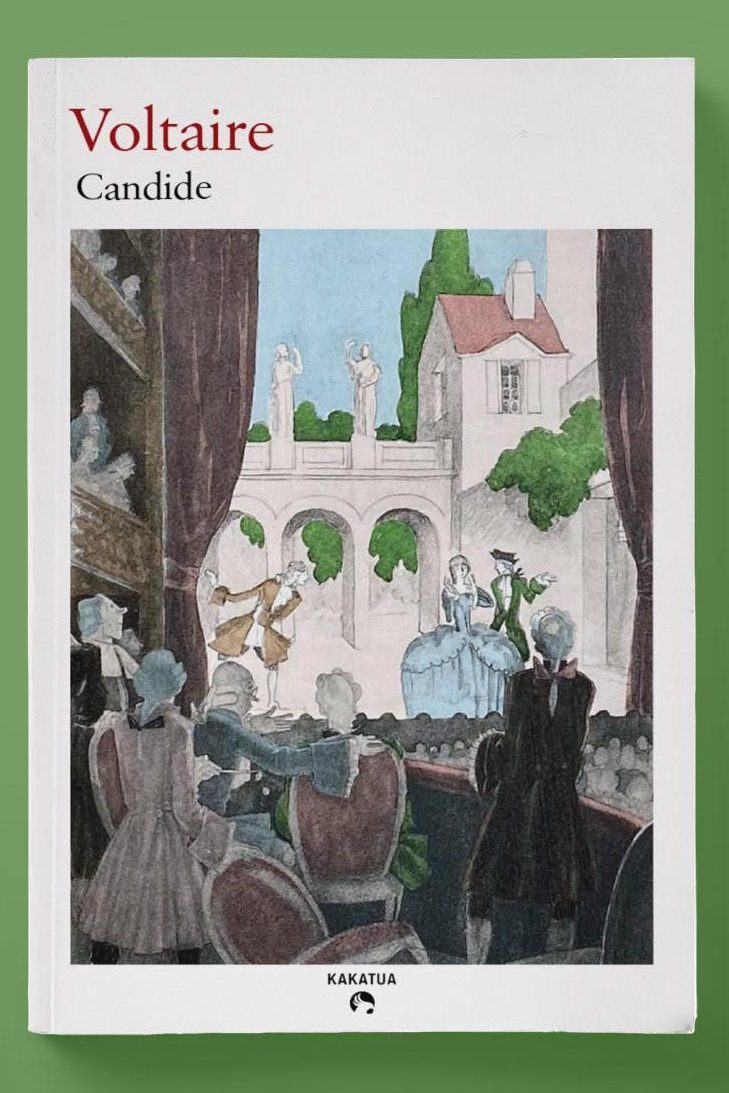
Candide or if translated, means optimism, is a book by Voltaire, a philosopher/thinker/whatever that means. Basically when Voltaire wrote this book, there was an ongoing philosophy by Leibniz, a church goer, which dictated that since God is benevolent, everything that has happened to us is the possible best thing.
When Voltaire wrote this book, he basically challenged the church, a dangerous move that could get his head on spikes, but he wrote it in such a way that it seemed harmless since it’s a fiction.
In this book, the main character, Candide, is not smart but very optimistic. He believed the Leibniz teaching since it was taught by his philosophy teacher, Dr. Pangloss, even though shit-tons of misfortunes have happened. Having finished this book will have you thinking a few things.
For me myself, the insight I got is:
Don’t judge someone based on intelligence.
See through the naivety.
Yes, there is evil in this world.
But some people are born pure.
Spare some space, give them a break.
Always see through the character.
Beneath that flesh, bone, and organs.
There is one invisible heart.
That connects us all beings.
After all, we are one.
Writing this is easy. But after imagining my annoying aunt who kept asking me when I got married, and another aunt who despised me because I rejected her proposal to match me with a distant relative, I find it very difficult to do so.
Long Story Short
I have my own rhythm, my own habit, and other personal things that I like.
Once I contemplated that if someone else comes into my life and start dictating what I should do and shouldn’t do.
How dare she?

Then recently I just watched a short film “Long Story Short” episode 2.
Inside, basically there is a conflict between a brother and a sister.
At one scene, the sister points out his brother’s bad habits, like not checking in with his family, or he’s too egoistic.
Sometimes we have bad habits.
And by connecting with someone close,
those bad habits can be pointed out, therefore it can help us grow
to become a better version of ourselves.
Things No One Taught Us About Love: Part II Final
I have read the whole book.
Yes as I have mentioned in part 1, basically it doesn’t answer my curiosity of how love between two people works. Instead it tells me the nature of love, which in itself is not romantic love at all. It is a state of being, of metta, of universal love. The feeling of wanting someone to feel happiness. He emphasizes us to have this kind of love be built upon ourselves.
His take on relationship between two people is very wise and it feels like it comes from true love: loving yourself first then you love another person. But the be honest it’s nothing I don’t already know, like respecting boundaries, lowering expectations, go easy on people, etc. But maybe for some people who do a little thinking or if you listen to relationship gurus who tells you the bare minimums for men, you should definitely read this book and rewire your brain before it’s too late.
The only thing I hoped were answered in this book was how people fall (or as he preferred, rise) in love in the first place. This one was not found in his book. Maybe if you know someone is the one, you will know, thus its absence.
Respect and cowardice
Just last night I had a lot of uncontrollable laughs. I laughed because I watched a lot of Pinkan Mambo compilation videos and Lina Mukherje. For Lina “Queen of Garmek,” because that was my first time being exposed to her contents. I was very much surprised by how insightful she was. After all, she was famous for being a little cray-cray. And apparently she learned from her experiences and contemplated from it. While listening to what she had learned from her experiences, I was reminded that there’s no one true recipe in life.
How I came to that conclusion was because I also realized everyone’s experiences are different. If Lina did something and faced injustice, doesn’t mean by following the same recipe, others will suffer the same fate. But one thing I appreciated about Lina was that she was wise enough to declare that her theory came from her experiences, not a rule that everyone should abide by.
Only after you respect yourself then others could respect you, too. Respecting yourself means you know exactly what you want and you go with it. That’s why I respected my angry neighbor who knew her boundaries and dared to face annoying neighbors, rather than my cowardly ex who was afraid of confrontations, with excuse such as avoiding conflicts. Avoiding unnecessary conflict sure is a must, but there are some problems we should dare face forward.
A few days ago, when driving a car, my car hit another car. My fault. My mother was in the car.
After the hit, both cars were moved to side of the road. For things like this, you have to be brave and face responsibility. My mom, scared, told me not to go down from the car. Like, what the f was that supposed to mean? I hit another car. My fault. And you expect them to come to our car while we sat like a coward? Needless to say I didn’t listen to the stupid suggestion. I came down and everything went well. I treated them with respect and thankfully they were both good people who knew mistakes happen. I asked for forgiveness, spent a little money, and we were both on our way.
In the end what I wanted to say was: I hate cowardice. Like, I really really hate cowardice. That cowardice is fine if you are by yourself, just don’t drag me into your cowardice lifestyle.
How I Imagined An Ideal Relationship
is between Phil and Claire. Respectful to each other.
Maybe relationship is not that complicated.
We just do it, and solve the problems ahead.
Problems stem from bad communication.
Things we’re afraid to say.
Sometimes even after good communication, there are still problems.
The next problem is immaturity.
Given good communication between each other,
relationship should have been going well.
We share our discomfort, and we find the middle ground, i.e. compromise.
But someone who’s immature, stays in place, not moving from where she stands.
Always her wishes that must be granted.
Or she takes, takes, and takes, never gives.
Because she thinks that’s what women are supposed to do.
I admit I’m immature, too.
Why would I leave the comfort I’m having right now,
and increase my spending by two fold or maybe thrice?
Maybe the key component I’m missing is love itself.
If I really love someone, things like that wouldn’t bother me at all.
Just like what other people do, who are willing to sacrifice everything,
even their own life,
for their lover.
An Insight from Things No One Taught Us About Love: Part I
When reading this book, I kinda get a sense of what the author wants us to be like, or in another word, what the author is like, if in his life he practices what he writes.
Imagine someone you know, whose mind is always positive. Some who’s always avoid thinking negatively about another person. Someone who’s vulnerable, brave, cheerful, unafraid of love, be the first one to approach people, who’s a radiant sun to people around him, who’s emotionally mature, who’s understanding, you never worry about saying wrong things to him/her, and an anchor to ships during deadly storm.
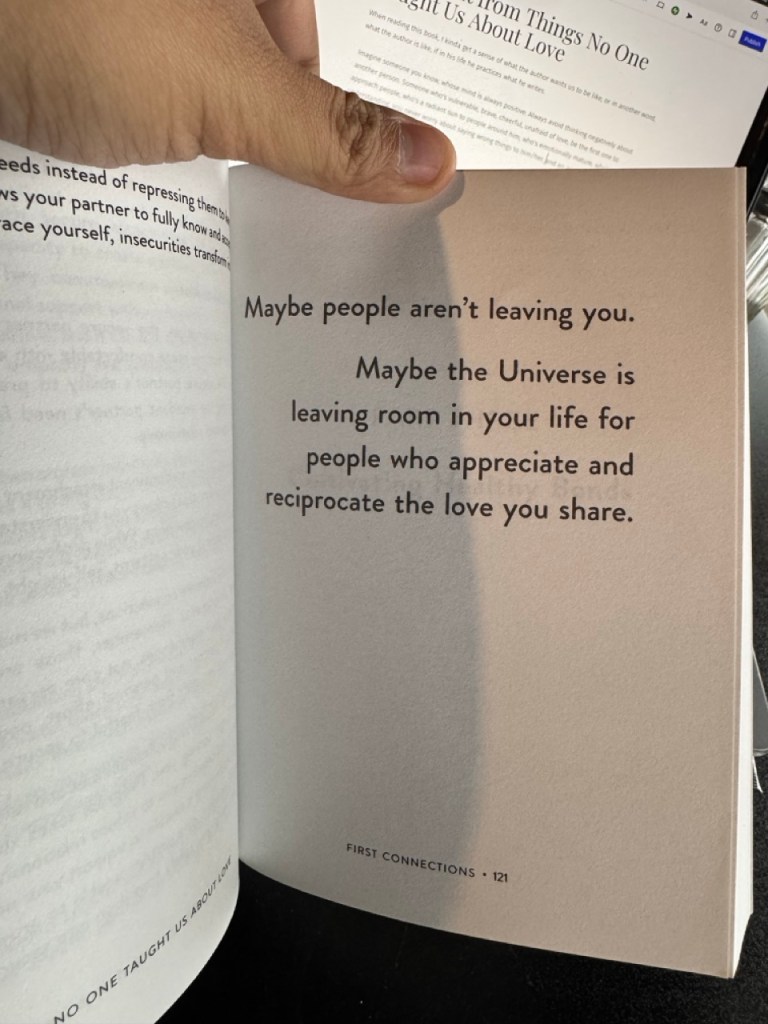
But what if I’m the one who’s always leaving?
and I have no love to share.
Heck I don’t even know what ‘giving love’ exactly means.
I mean, just being present is enough? I help people if they ask for help. Is that giving love enough?
dude…
I should get tested
for sociopathy. 😀
While writing this, a song from Amy Winehouse was playing: Love is A Losing Game.
Love is a losing game
One I wished I never played
Oh, what a mess we made
And now, the final frame
Love is a losing game
I love this song as it teaches us one of love’s core: whoever loses, they win.
Selfishness in me
Am I selfish?
If I make my niece laugh
not only to make her happy
but because I enjoy seeing her laugh
in the end, what I do bring happiness back to me
if making her happy
put me in a miserable position
no, I won’t do it
with this intention and realization
am I self serving?
Things No One Taught Us About Love
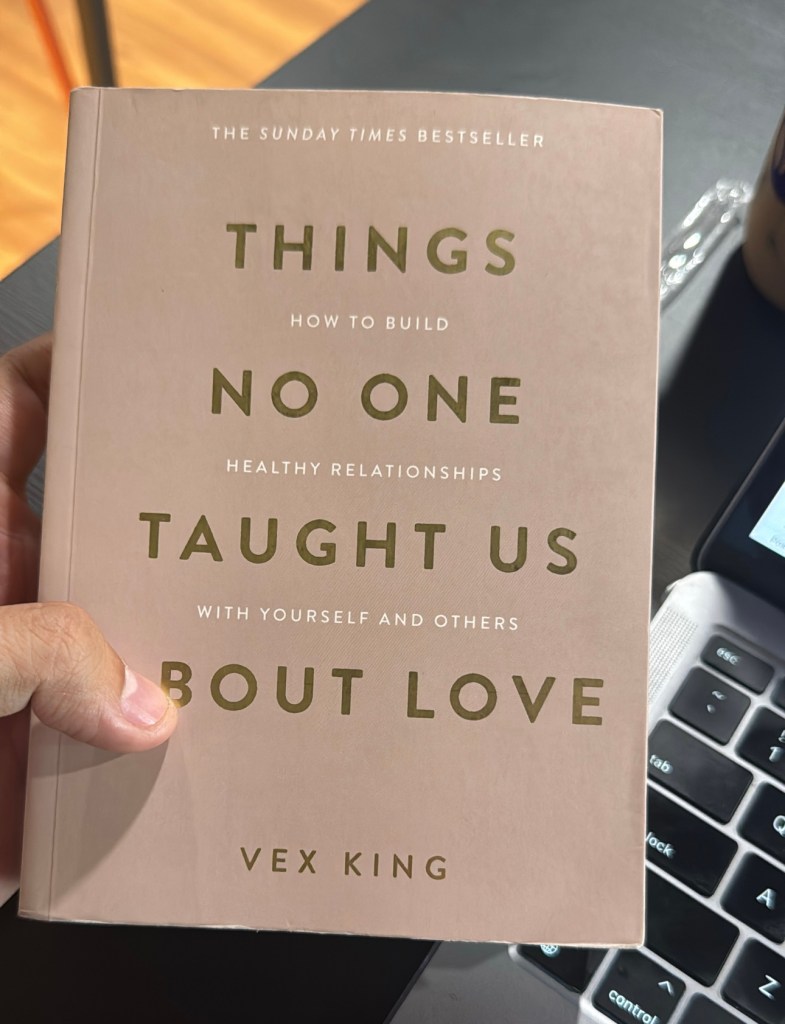
When I first encountered this book at Periplus, it was wrapped in plastic.
I couldn’t check what was inside.
As a robot who is learning about human behavior, this intrigued me, and I wanted to know how love works. I expected the contents would be something like, how relationship worked, how it should be.
But after reading into half the contents, I found that this book is mostly about self-love, which is true actually.
1. Loving yourself is the greatest form of love, just like Whitney Houston’s beautiful song.
2. Only after loving yourself, you can start loving other people.
And in chapter one, Vex King explained the nature of love. After reading chapter 1, his definition of love is divine love, or in Buddhism, metta. The great love. Love for all beings, even to the unworthy. Love to the whole universe.
While talking about this, there’s this sutta in Buddhism that I really loved. Basically it taught you to grow and spread your love to the universe. Doesn’t make sense, right? Maybe it’s not effective or beneficial to other beings we are spreading this invisible love to, but it is beneficial to our own selves, it brings to me some degree of peaceful feeling and happiness. Here is the link if you’re interested.
About self love, I think I have enough of it. That’s why I don’t seek validation anywhere else, thanks to how I was brought up. I notice that loving others are often a form of lust and self-serving desire. Like, when someone says she loves me, it doesn’t mean that she wishes my happiness. More often it means that she desires her own happiness which can be realized by being with me. I can sense what exactly she means by that. And even in the smallest form that even she doesn’t realize, I can know. Like I mentioned a few posts ago, I sense these kind of things by instantly analyzing the motives. I imagined another condition when I: am not rich; am not handsome. Would she still like, or even interested in me? The answer is mostly no. This sensitivity has helped me most times, but it also broke me. But as Tyrion said, “wear it like armor and it can never be used to hurt you.”
For this reason that’s why I am skeptical with people, knowing my background, praise me too overly even though they don’t know me personally. It happened once when I was matched with some far distant relative and I met with her family. I prefer people who just act normally and respectfully to people they just meet, this way we can build trust and respect together.
From observing people I also realize the possible truth. Maybe women multiply the love you gave them. You have to do it first. Maybe other people do it instinctively. I don’t. Maybe I already feel abundantly loved. Maybe that’s why children from broken home family are usually “wilder” in their teenage years. Not saying that it’s bad. I’m saying that it’s human. Our core value of being is to be loved. No one ever taught us how to love ourselves. It’s very normal that those teenagers seek love elsewhere. (Wow lots of maybes in one paragraph)
Or could there be another perspective? Sometimes people talk about loneliness when talking about needing a relationship. We don’t necessarily love someone, but we need them to make us feel less lonely. So somehow it’s like a mutualism symbiosis. It’s like having a loyal companionship for life. But for me myself, as someone who’s self sufficient most of the times, I have been by myself since college times, or maybe far before that. I was told that as a child, I don’t like to interact with others. When my cousins came to my house, I would resort back to my room, laying on the floor, bring up a pencil and a paper, and start drawing. Even during college times, there was a time I rarely interacted with people. I came to campus, listened to lectures, then going back home, then playing games, sometimes I explored new restaurants. If I seemed like an extrovert to you, it’s one of my learned trait. But my nature couldn’t lie. If I hang out with you, after 2 or 3 hours you will see tiredness in my eyes. They say lack of interaction with other human beings could make us less healthy physically. I don’t know about that. But if someone becomes my close friend, then it means he has been through my invisible filter, it means he’s a good person. Not necessarily perfect but he’s morally good or has a good heart.
After all, I’m only at chapter 2 of this book. So after reading more about it. Maybe I’ll write more about it. For now, that’s about it.
 Goofythinker