Overthinking in 5 seconds

Baru tadi siang saya membeli siomay.
Ketika abangnya sedang menyiapkan siomaynya: mengambil dan memotongnya, saya pergi ke motor saya untuk mengambil uang cash, jarak hanya sekitar 3 meter. Namun pada saat saya berjalan menuju ke arah motor, saya khawatir kalau abangnya akan mengira saya pergi tanpa membayar. Sehingga ada sedikit keinginan saya untuk memberitahu abangnya kalau saya hanya mengambil uang dari motor. Padahal dengan jarak sependek itu, saya tidak perlu meyakinkan abangnya apapun. Saya hanya cukup diam dan bergerak menuju ke motor.
Terdengar konyol, kan? Jarak hanya 3 meter, dan saya mengkhawatirkan hal seperti itu. Namun untuk lebih akuratnya, ada bagian dari diri saya yang khawatir, karena secara otomatis juga, ada counter self-talk, yang meyakinkan saya kalau hal tersebut tidak usah dihiraukan.
Pada saat itu, dari luar, saya terlihat percaya diri dan terlihat tidak memikirkan hal apapun.
Semua itu terjadi dalam waktu kurang dari 5 detik.

Trilogi Diri

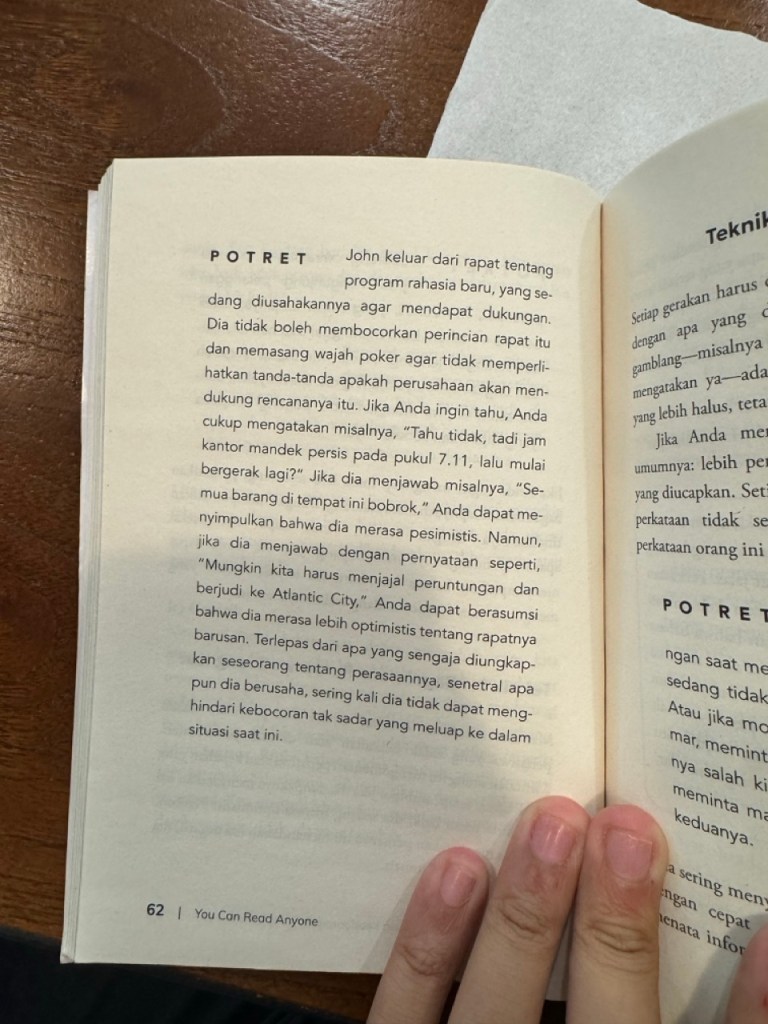
Saya menemukan sesuatu yang menarik ketika sedang membaca You Can Read Anyone by David J. Lieberman.
Hal ini tidak ada hubungannya dengan cara membaca orang lain, akan tetapi hal ini berkaitan dengan membaca diri sendiri.

Dalam hal ini, di dalam diri kita diibaratkan terdiri dari 3 unsur:
Jiwa, Ego, dan Tubuh.
Jiwa akan berusaha melakukan hal yang benar.
Ego akan berusaha melakukan hal yang terlihat benar.
Tubuh akan berusaha melakukan hal yang terasa enak.
dan setiap hari mereka berperang satu sama lain.

Semisal ada mobil baru yang ingin kita beli walaupun keuangan tidak memadai.
Jiwa kita tahu bahwa membeli mobil adalah hal yang salah.
Namun ego akan meyakinkan diri kalau membeli mobil tidak ada salahnya.
Di bagian ini, tubuh tidak terlalu terlibat.

Lalu misalkan pada pagi hari weekend ketika kita sudah berjanji kepada diri sendiri untuk berolahraga,
Jiwa kita tahu bahwa kita harus berkomitmen untuk berolahraga pagi,
Ego kita juga berusaha meyakinkan untuk berolahraga, namun motivasinya adalah supaya teman-teman kita tidak berkata kalau kita ingkar janji,
Namun tubuh kita berkata untuk lanjut tidur saja karena tidur nyaman sekali.

This realization sangat menyadarkan saya akan pilihan-pilihan sehari-hari saya selama ini. Sebelum membaca buku ini, saya tidak menyadari hal tersebut ada. Oleh karena itu saya ingin share juga ke pembaca yang ada di sini.

Realisasi ini juga membuat saya berpikir.
Ada hal-hal yang tidak bisa saya sadari hanya dengan berpikir sendirian.
Ada hal-hal yang dipelajari dan sudah dipikirkan oleh orang lain, dan bisa sangat bermanfaat apabila saya mempelajarinya.

On Friendship

Dalam kehidupan, kita sudah pasti berteman. Seburuk-buruknya sifat seseorang, pasti setidaknya dia memiliki seorang teman. Termasuk saya.

Setelah saya memperhatikan sekeliling saya tentang pertemanan, kadang saya merenung. Apakah ada pertemanan yang sejati?

Saya memperhatikan kedua orang tua saya dan orang-orang yang usianya lebih dari 50 tahun.
Kebanyakan mereka berteman dengan orang yang tinggal berjarak dekat dengan mereka.
Atau memiliki kesamaan yang membuat mereka bertemu secara rutin, misalkan kalau anak mereka bersekolah di tempat yang sama, atau kerja di tempat yang sama.

Teman-teman lama mereka, seakrab apapun sewaktu dulu, pada akhirnya hanya akan bertemu setahun sekali, atau 5 tahun sekali.

Bukan maksud saya untuk mendiskreditkan persahabatan mereka dengan mengatakan bahwa pertemuan setahun sekali dan 5 tahun sekali tidak terlihat seperti sebuah persahabatan, akan tetapi akan berbeda teman yang bisa kita temui setiap hari dengan teman yang kita sangat jarang temui. Mungkin mereka sesekali tetap berkabar melalui media sosial, akan tetapi kalau dari pengalaman saya sendiri, tanpa kontak fisik, tatap mata secara langsung, perlahan-lahan persahabatan akan memudar. Misalkan dahulu saya bisa ingat apa yang sedang terjadi pada mereka, kesulitan yang sedang mereka hadapi, dan kita peduli. Kalau sekarang, apabila mereka menceritakan kondisi mereka ke saya, jujur saya sulit mengingat secara detail. Saya hanya bisa ingat secara samar-samar. Berbeda dengan teman yang kita temui secara langsung.

Persahabatan saya perlahan memudar oleh jarak.

Kebetulan sekali ketika menulis bagian ini, tiba-tiba lagu dari playlist saya, “That’s What’s Friends Are For” berputar.

Aku menutup mata, mendengarkan sambil tersenyum,

Keep smiling, keep shining,
Knowing you can always count on me,
That’s what’s friends are for.

Mengenai pertemanan juga.
Seindah-indahnya cerita orang tentang pertemanan yang mereka miliki.
Terkadang bisa runtuh karena uang.
Oleh karenanya saya terkadang merasa secara tidak sadar telah membangun dinding.
Dinding agar orang lain tidak bisa masuk terlalu dalam.
Ada batas-batasan seakrab apapun kita berteman.

Berdasarkan apa yang saya amati dari orang-orang di luar sana,
pertemanan yang rusak akibat bisnis,
membuat saya menghindari melakukan bisnis bersama teman.
Karena seberapa akrab dan dekat, bahkan seperti saudara, antara saya dengan teman saya,
saya tidak bisa membaca pikirannya.
Adilnya, terkadang saya pun tidak yakin dengan pikiran saya sendiri.
Bagaimana saya bisa yakin 100% dengan orang lain?
Haruskah saya menjadi vulnerable?
Berdasarkan penelitian Dr. Brené Brown, hidup yang berharga adalah hidup yang vulnerable, kita mencintai dengan berani, lalu kita berani juga tersakiti karenanya, dan kemudian bangkit kembali.
Entahlah, saya tidak tahu.
Tidak ada rumus yang pasti di dunia ini.
Untuk saat ini, karena saya sayang dengan teman-teman saya, dan tidak ingin merusak pertemanan, saya memilih untuk membangun dinding, dan menjaga yang sudah ada.

On feeling happy with other’s success

Turut bersedih ketika ada orang lain yang bersedih itu mudah.
Lebih sulit adalah turut bersuka cita atas keberhasilan orang lain.

Tapi kemudian pertanyaannya adalah,
kenapa kita harus ikut bersedih kalau ada orang yang bersedih?
lalu kenapa kita harus ikut bersukacita kalau ada orang yang sedang merayakan keberhasilan?
Kenapa tidak netral saja?
atau membiarkan emosi yang muncul menjadi emosi yang muncul.
Tapi tindakan kita tetap menyesuaikan dengan norma masyarakat.
I know our thoughts and emotions will influence what we do next.
But what if we are able to remove thoughts and emotions?
and we are sure that they don’t influence what we do.
We just do what must be done.

Wait a second….

Am I…. a sociopath?

Envy

One of the most misunderstood emotion is envy.
People say, envy is bad, don’t envy,
take inspiration, learn from them.
Well the thing is, envy is an emotion.
Have you ever see someone so successful, and think,
“I think I want to envy him.”
Never, right?
It comes automatically.
You see something more than what’s yours, envy blooms.
We are never in control.

The feeling of envy is very human,
It’s embedded deep in our DNA.
It is the fuel for growth.
To compete, to win the battle of survival.
It’s the result of natural selection,
Those that don’t envy, refuses to grow, lost in the gene pool.

After realizing what envy is,
here is what we can do whenever envy arises.
Recognize what you’re feeling.
Emotions are emotions.
They are not a part of you.
It is simply a physical response from the brain.
Let the envy flows, let it thrive, but don’t let it become the part of you.
Envy happens to the body,
and you are just a soul inhabiting a body.

When Meteor Hits Earth

First a small light in the sky, just like a star
Each night grows bigger
They say the end of the world is here
3 more months
It’s funny how people chase things after things
To fulfill what they believe will amount to anything
When in the end, not one thing of us will be left

Everything will be wiped out
Not even your name will be left
No memory will be spared
Everything you worked so hard to build
Everything you convinced will amount to something
No one will know
No witness
All dead
Pure extinction

The blind man and the rich scammer

I know one blind man, who sells crackers, walking door to door. He never asks for pity, he sells with reasonable price. When I stopped him on the road, he just kept silent until I asked the price. Fifteen thousand rupiah, he said. It was a very normal price for a pack of crackers. He didn’t upsell, at all. Usually, out of respect, I gave him more. I am proud of him, and he should be proud of himself.

I also know one rich man. He got rich by scamming a lot of people. First of all, he rented expensive things and claimed those things as his own. He claimed he was able to afford those things after using a method he knows. If someone wanted to learn to be as rich as him, he had to pay certain rupiah to join his class. But actually his class didn’t teach about anything. He got rich by hopeful people paying for his class.

I see more value in the blind man. A sane person would, too.

But this world is full of insane people. They see a person’s value by their wealth. If someone is poor, they won’t even look at him. I am disappointed by how people can worship money that much.

How insane someone is can usually be seen by how they talk about rich people. They talk about rich people like they talk about their God. Praise them by the amount of money they earn. Being proud of them as if their money is their own. Being ecstatic just by talking about them.

I always see money as only a blessing from God. Whether you have it or not is by His grace. But what puts value in human being was his attitude towards other humans. I see obnoxious rich people’s value as lower than my housekeeper’s value, who worked diligently and honestly.

The Next Conversation: Final

It’s final already because I already finished the book.
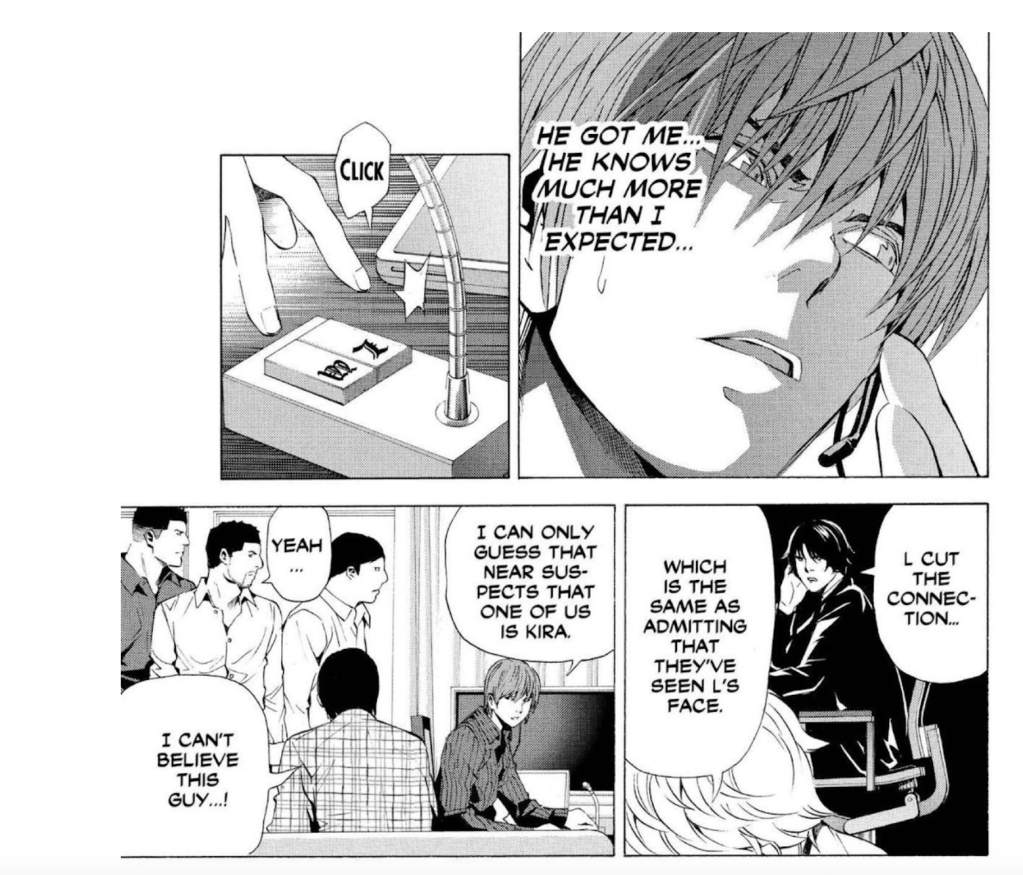
Only after finishing the book that I realize, we don’t really need to finish a book by reading through all pages thoroughly, especially self-development non-fiction books. Because sometimes there are pages that might not be relevant to us.

For this book specifically, I bought and read this book because I expected that after reading this, then when I had a conversation with someone, mostly strangers or someone I’m not really close with, I can have smooth conversation.

But apparently this book is not about that.

Basically this book tells you how we can have meaningful conversation with someone if we already have the purpose of the interaction, such as we want to tell them about something, we want to have discussion, we want to fire them, etc.

For me, whenever I already know what the interaction’s going to be, I find it easy to have conversation. The hard part is when we don’t really have anything to talk about, but I want to make conversation.

So, the conclusion is that I’ve read this book for nothing. Well not really, there’s a lot of insight I got from this book that I could use when I finally need to have a difficult conversation. The best ones are:
1. Never win an argument, seek to understand.
2. Control the moment: take a breath, do a quick scan, have a small talk to yourself.
3. Control the pace: use pause strategically.
4. Frame your conversation.
5. Always have the positive mindset.
6. Recognize narcissist and deal with them accordingly.

There are also a lot of things I learned by reading this book, that is not only about how to have meaningful conversation. It happened just today.

Just today I talked with my family member about our vice president, Gibran. I told her about the news that he invited fake online drivers to have a talk. And not long after, his fake online drivers representative gave a statement, more or less, “Chicken burglar got sentenced 5 years, Affan’s killer only got special arrest?” I told her that Gibran was dangerous to the president, Prabowo. He tried to appeal with masses, so that Prabowo falls, then he becomes President. She answered, “good.”

Good? What do you mean good? Do you still believe Gibran is one of the good guys? I know you are Jokowi’s fans but how can you be so stupid? I know your opinion doesn’t matter since you are not that smart. All your academic achievements was because you studied diligently, but try your logic. Pretty sure it sucks.

My blood rushed to my head. Those are all I thought in a few seconds. But I kept my silence. Then I asked myself, what made me so angry from her “good” answer. Then I realized, this is what is taught in this book. This is one of my trigger. When she said that, to me it was a threat to my personal identity. My belief is that Gibran is one of the bad guys. By saying that, she basically questioned my judgement that Gibran is a bad guy. By questioning my judgement, subconsciously I perceived that my intelligence was also being questioned. That’s why I was so angry.

By recognizing this, then I took a breath and controlled myself. Realizing that maybe everyone was exposed to different bubble of information. I could be wrong, too (even though when I’m writing this, I’m sure with myself.) And however smart or stupid she was, it didn’t matter, she was a person that needed to be respected. And a disagreement was just a disagreement, it was not an attack to my intelligence. I kept my composure, my head still ran a little hot, but I told myself it was a physical response of my subconscious self. My conscious self knew better.

After her comment, I just kept silent and basically ignored it since it was a light conversation. I learned that it is best to avoid politic-related topic if you already know the other party has opposing views with what you believe is true. If you don’t know, don’t start. If you know you have the same view, it means it’s safe to talk.

In conclusion, apparently this book is pretty useful.

15 years

I’m super introvert, in case you don’t know it yet.
I’m so introverted at one point in my life, I had a very minimum interaction with people for almost 3 months, and I was totally fine.

I told this to someone I knew, and she commented that even though I’m introverted, my mind was not dark or twisted enough like most introverts. I was disappointed (jk, no really.) Maybe I didn’t give that impression, so I’ll try my dark version by writing a poem. Here it goes.

15 years

It’s been 15 years
Each night an eternity
O’ moon my only friend
I long for your breath, your touch
Your presence whispers home
Home long gone
Now you I thirst
The only comfort I know
Have you known the hell I’m in?
Death don’t fear me no more
For in death I’m forever with you